How Many Jobs Should You Apply to a Day?
Apply to 2 to 3 jobs a day by hand, or 10 to 15 a week. See how the number changes for your situation, and what to fix if you aren't getting interviews.

· 10 min read
Key takeaways
- Apply to 2 to 3 jobs a day if you're applying by hand, or 10 to 15 a week. How well each application fits the job matters more than how many you send.
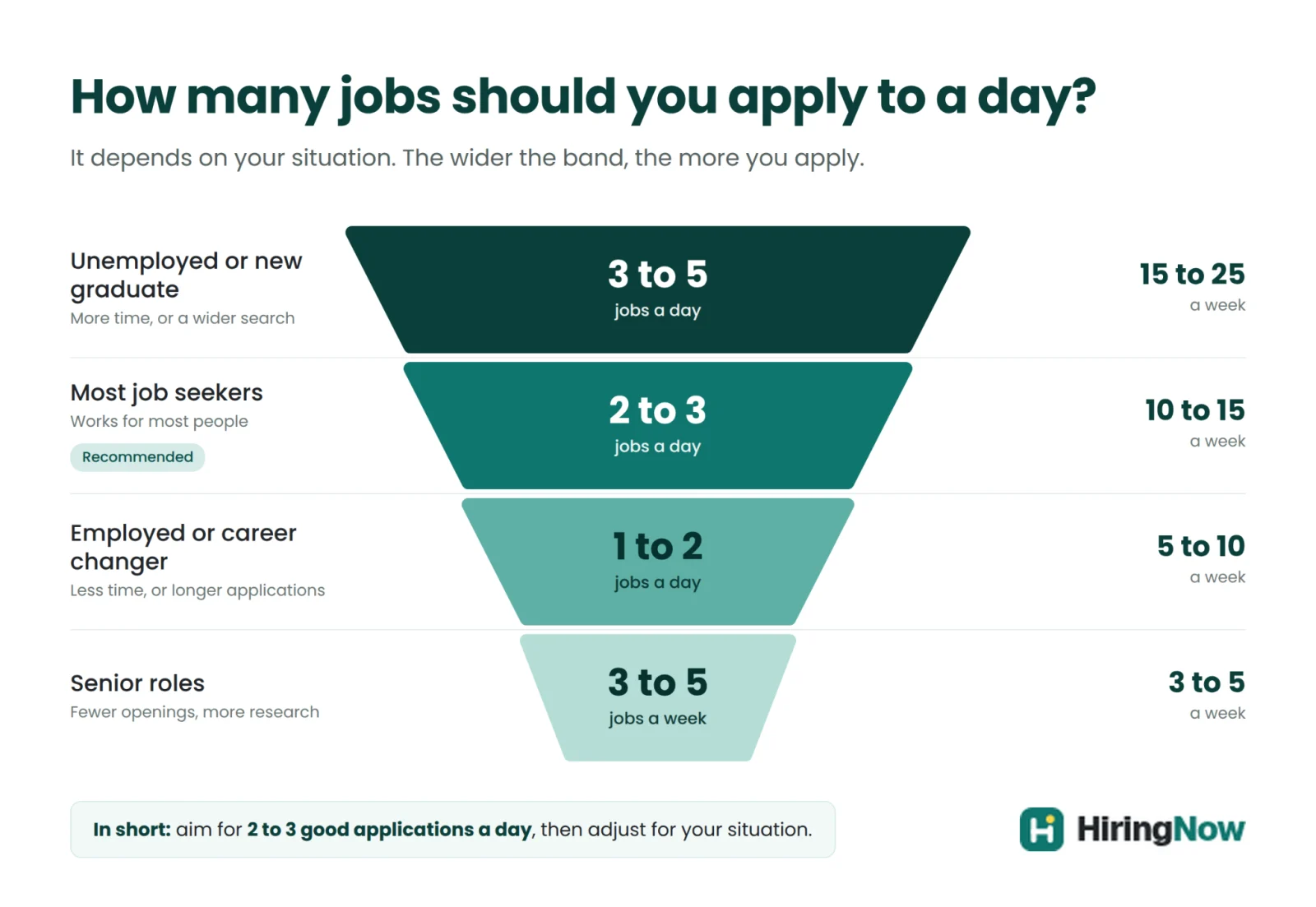
- If you have a job or are changing careers, 1 to 2 a day is enough. If you're unemployed or a new graduate, go up to 3 to 5. For senior roles, 3 to 5 a week.
- With a tool that tailors your resume to each job and applies only to jobs that match your profile, you can apply to more, often 5 to 15 a day, as long as every job is a real fit.
- If 30 to 40 tailored applications bring no interviews, stop sending more and fix your resume, the jobs you choose, or both.
- Apply early: only 10% of open jobs were posted in the past week, and new jobs get the most attention in their first few days.
On this page
- How many jobs should you apply to a day?
- How many daily applications fit your situation?
- Employed: 1 to 2 jobs a day
- Unemployed: 3 to 5 jobs a day
- New graduate: 3 to 5 jobs a day
- Career changer: 1 to 2 jobs a day
- Senior roles: 3 to 5 jobs a week
- Why doesn't sending the same resume to more jobs get more interviews?
- Not getting interviews? Here's what to fix
- Pick jobs that fit you
- Match your resume to the job
- Avoid stale listings
- Get a second opinion
- Talk to someone inside
- How can you apply faster without losing quality?
- How does HiringNow help you apply faster?
On average, about 254 people apply to each job posted on Greenhouse, according to Fortune. With that much competition, it's easy to think you should apply to as many jobs as you can every day.
But sending more of the same application doesn't get you more interviews. Applications per job more than doubled in three years, from 116 in 2022 to 244 in 2025, according to Greenhouse's hiring benchmarks. Each job still hires one person, so sending the same resume to more jobs just puts you in a bigger pile.
In this guide, you'll learn:
- Why 2 to 3 applications a day works better than applying to everything
- How the number changes if you're employed, unemployed, a new graduate, or changing careers
- When it makes sense to apply to more jobs, and how to do it without losing quality
- What to fix if you aren't getting interviews
How many jobs should you apply to a day?
Apply to 2 to 3 jobs a day if you're applying by hand. Over a five-day week, that comes to 10 to 15 applications.
This number works for three reasons:
- Good applications take time. Reading the job description, adjusting your resume, and answering the questions takes about 30 to 45 minutes per job. Two or three a day means 1 to 2 hours of focused work.
- Good matches are limited. On most days, only a few new jobs truly fit your skills. Beyond those, you start applying to jobs you don't want or can't get.
- You can keep it up. A job search often takes months. The median unemployed person in the US has been out of work for about 11.5 weeks, according to the Bureau of Labor Statistics (September 2026). A steady pace works better than 50 applications in one week.
| Pace | Per day | Per week | Best for |
|---|---|---|---|
| Light | 1 | 5 | People with a job and little free time |
| Recommended | 2 to 3 | 10 to 15 | Most job seekers applying by hand |
| Upper limit by hand | 4 to 5 | 20 to 25 | A full-time search with plenty of good matches |
| With an auto-apply agent | 5 to 15 | 25 to 75 | A broad search where every application is still tailored and approved |
Treat these numbers as a guide, not a rule. The limit by hand is your time. With a tool that tailors each application for you, the limit becomes how many jobs truly fit. If you find five jobs that fit you well, apply to all five. If nothing fits today, it's fine to send none.
How many daily applications fit your situation?
Two to three a day suits most people, but your time and experience can move the number up or down.
Employed: 1 to 2 jobs a day
- Weekly target: 5 to 10 applications
- When to apply: Evenings or weekends, never from your work laptop or work email
- What to apply for: Only jobs that are clearly better in pay, role, or growth
You already have an income, so there's no need to rush. That lets you be picky and put real effort into each application. A slow, careful search also keeps your current job safe while you look.
Unemployed: 3 to 5 jobs a day
- Weekly target: 15 to 25 applications
- How to plan your day: Applications in the morning, then networking, follow-ups, and building skills
- What to avoid: Going past 5 a day by hand, since that usually means you've stopped tailoring
With no job, it's tempting to apply all day. But a search with fixed hours is easier to keep up for weeks or months. Treat it like a job, finish your applications for the day, and then stop.
New graduate: 3 to 5 jobs a day
- Weekly target: 15 to 25 applications
- Where to look: Several similar job titles, not just one
- What to show: Internships, projects, and coursework
- Extra help: Your college career center and alumni network
Entry-level jobs get a lot of applicants, and you have less experience to show than most of them. Applying more widely gives you more chances. Each application still needs a resume that matches the job, so don't trade quality for numbers.
Career changer: 1 to 2 jobs a day
- Weekly target: 5 to 10 applications
- Resume: Rewrite it around the skills that carry over to the new field
- Cover letter: Explain why you're making the switch
- Extra help: Talk to people who already work in the field
Each application takes longer because your past job title won't match the new role. You have to show the employer how your experience fits. A few strong applications will do more for you than many weak ones.
Senior roles: 3 to 5 jobs a week
- Weekly target: 3 to 5 applications
- Before you apply: Research the company, its problem, and how your experience solves it
- Where offers come from: Referrals and recruiters, so spend the rest of your time on your network
There are fewer openings at this level, and each one takes hours to apply for properly. Employers expect you to understand their business before you speak to them. That's why a handful of well-researched applications is the right pace.
Why doesn't sending the same resume to more jobs get more interviews?
It feels like more applications should give you more chances. The problem isn't the number. It's sending the same untailored resume to every job, and three things get in the way.
| What gets in the way | What the data says | What to do |
|---|---|---|
| Many postings never lead to a hire | Fewer than 1 in 2 US job postings now results in a hire, according to Revelio Labs | Apply to recent jobs that are also listed on the company's own career page |
| Resumes that don't match get screened out | 88% of employers say qualified candidates are screened out because they don't match the exact criteria in the job description, according to Harvard Business School | Adjust your resume to each job description before you send it |
| Recruiters have less time for each application | The average recruiter handled 4,890 applications in 2025, up from 1,610 in 2022, according to Greenhouse | Put your most relevant experience at the top, where it's seen first |
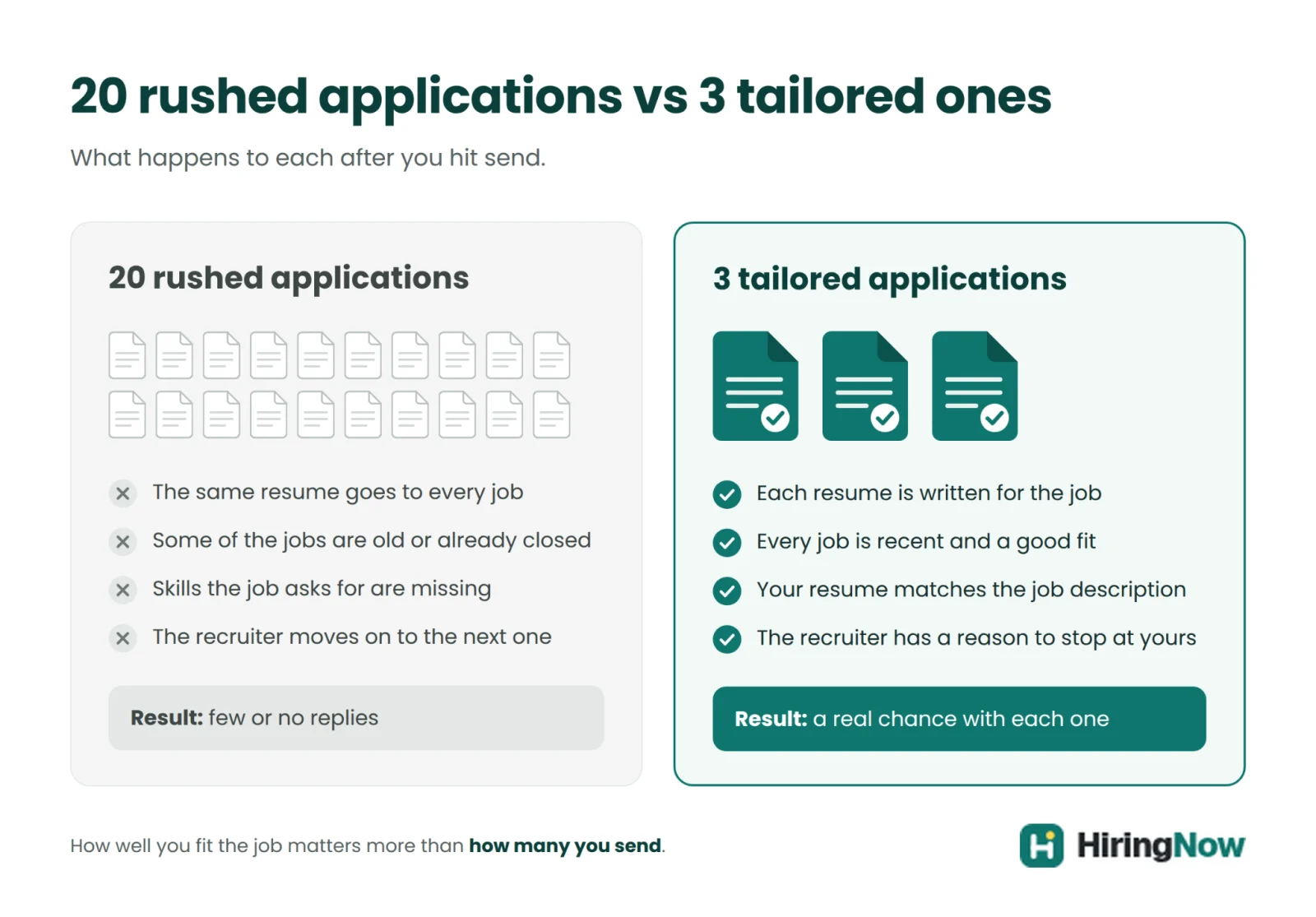
When you rush a lot of applications at once, you send the same resume to all of them. Some of those jobs aren't even open anymore. For the rest, your resume doesn't match what the company asked for, so the recruiter moves on to the next one.
That's why 20 rushed applications a day don't help much. Three good ones, each written for the job, give you a much better chance. And if you apply to more, each one needs the same care.
Not getting interviews? Here's what to fix
If you've sent 30 to 40 tailored applications without an interview, sending more won't help. Stop and check these five things first.
Pick jobs that fit you
Go back through your last 10 applications. If you met less than about 70% of the requirements for most of them, that's the problem. Apply to fewer jobs, and choose the ones where your experience clearly fits. On Greenhouse, people who marked a job as their top choice were hired about five times as often as everyone else, according to Fortune.
Match your resume to the job
Put your resume next to a job you were qualified for and compare them. If the main skills from the posting aren't on your resume, add the ones you have, using the same words the posting uses. An ATS resume checker does this for you and shows which keywords are missing.
Avoid stale listings
Some jobs stay online long after the company stops hiring. In our study of 68,610 open jobs, the median posting was 54 days old, and only 10% had been posted in the past week. Skip posts that are more than a month old, keep getting reposted, or don't appear on the company's own career page. Not sure how old a listing is? A job posting date checker shows when a job was first posted.
Get a second opinion
Show your resume and one or two recent applications to a friend, a mentor, or someone in your field. You've read your own resume too many times to spot what's unclear. Someone else will catch it at first glance.
Talk to someone inside
Don't rely on the application form alone. Message someone who works at the company, tell them which role you applied for, and ask a short question about the team. An application that someone inside has heard about gets more attention. 40% of referred candidates get an interview, compared with 3% of people who apply on their own, according to Ashby.
Fix one thing at a time and give it two weeks. If replies start coming in, you've found the problem.
How can you apply faster without losing quality?
Two to three good applications a day shouldn't take up your whole evening. These six habits cut the time for each one without lowering the quality.
- Keep one master resume. Put all your jobs, skills, and results in one long file. For each application, make a copy and keep only the parts that fit the job.
- Match your resume to the job description. Read the posting and note the main skills it asks for. If you have them, make sure your resume uses the same words.
- Apply early. New jobs get the most attention in their first few days. Set up job alerts so you see them as soon as they're posted. Job boards can lag behind: in our LinkedIn study, 48% of jobs listed as posted in the past hour had first been posted by the employer more than a day earlier.
- Save your answers to common questions. Forms ask the same things again and again, such as work authorization, notice period, and expected salary. Keep your answers in one document and paste them in.
- Track every application. Note the company, the role, the date, and which resume you sent. A job application tracker stops you from applying twice and tells you when to follow up.
- Let a tool do the form filling. An auto-apply tool can find matching jobs, tailor your resume to each one, and fill in the application. Choose one that lets you review each application before it's sent. Our comparison of the best auto-apply tools covers how the main ones differ.
How does HiringNow help you apply faster?
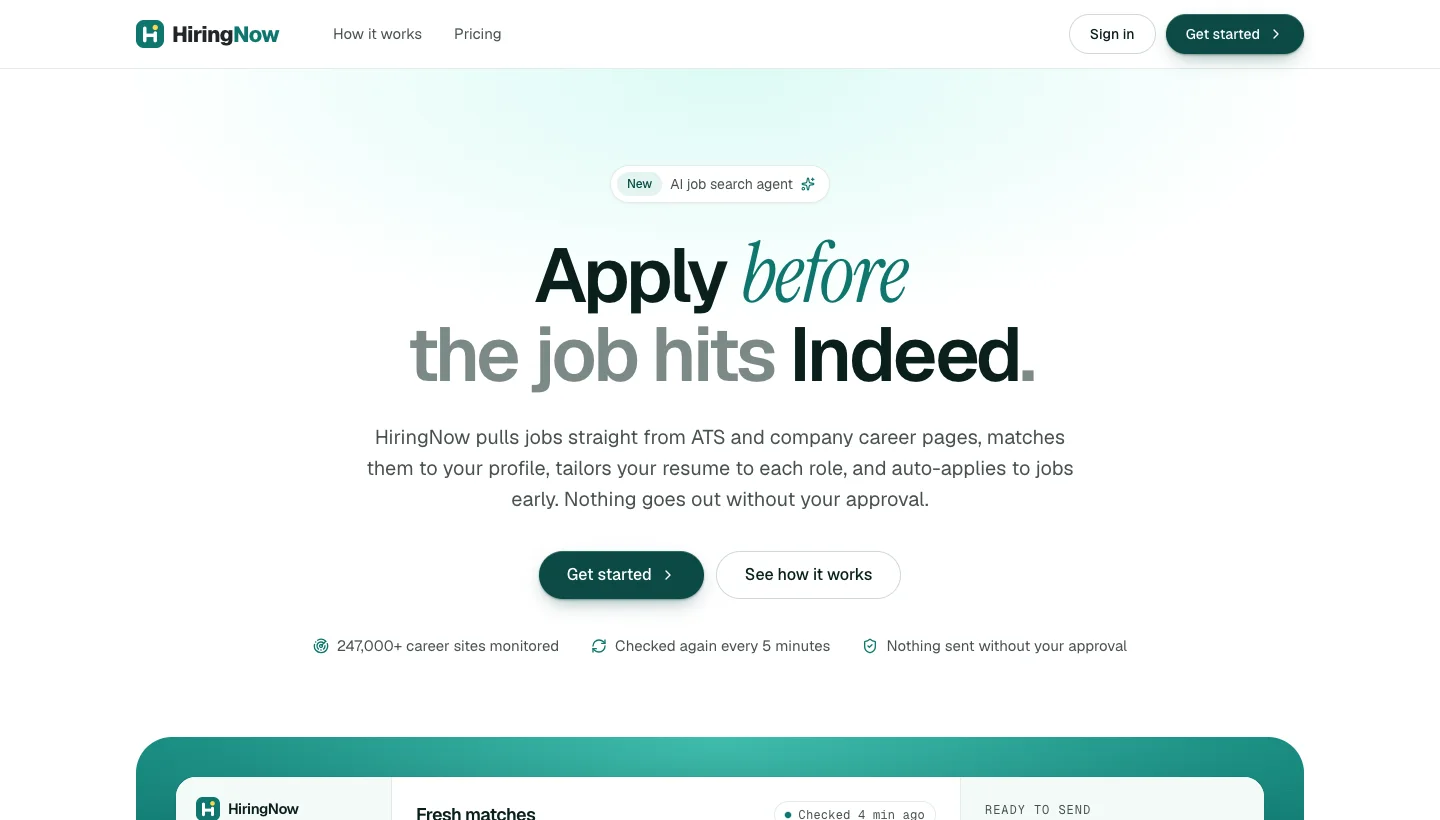
HiringNow is an AI job search agent that does the slow parts of applying for you. It checks 247,000+ company career sites every 5 minutes, finds new jobs that match your profile, and tailors your resume to each one.
You stay in control. It fills in the application, but nothing is sent until you look it over and approve it. It applies only to jobs that match your profile and rules, so a higher monthly limit means a wider search, not more spam. That's how you can apply to more jobs without sending the same resume to every one.
It also covers the rest of your job search in one place:
- An ATS resume checker that scores your resume against the job description
- One-click autofill for jobs you find yourself
- An AI resume builder
- An AI cover letter generator
- AI mock interviews
- A job application tracker
- A job posting date checker
You can start free with 10 auto-applies, and no card required. Paid plans start at $29 a month, or about $20 a month billed quarterly.
Frequently asked questions
How many jobs should I apply to per week?
Aim for 10 to 15 a week, which works out to 2 to 3 each weekday. If you already have a job, 5 to 10 a week is enough, since you have less time to spare. If you're searching full time or you're a new graduate, you can go up to 15 to 25. Spread them across the week instead of sending them all in one day, so each application gets proper attention.
Is 10 job applications a day good?
By hand, it's too many for most people: you can't read 10 job descriptions and tailor your resume well for each one in a single day, so the quality drops. With a tool that tailors each resume and applies only to jobs that match your profile, 10 a day can work, if they're 10 good fits and not 10 random listings.
What is the 70/30 rule in hiring?
It's a rule of thumb some recruiters use: hire someone who meets about 70% of the job requirements and train them on the other 30%. For you, it means you don't need to match every line in a job description. If you meet around 70% of it, go ahead and apply.
How many applications does it take to get a job?
There's no fixed number. It depends on your field, your experience, and how well each application fits the job. As a rough guide, if you've sent 30 to 40 tailored applications without an interview, the problem is your resume or the jobs you're choosing, not the number.
Can I apply to more than one job at the same company?
Yes, as long as the roles are close to each other and you fit both. Two or three is fine. Applying to every opening at one company makes it look like you don't know what you want.
How can I apply to jobs faster?
Keep one master resume and cut a copy for each job, save your answers to common form questions, set up alerts so you see new jobs early, and track every application. An auto-apply tool such as HiringNow can also find matching jobs, tailor your resume to each one, and fill in the forms, with nothing sent until you approve it.
Sources
- The Hire Standard: 2026 recruiting benchmarks, Greenhouse
- Greenhouse CEO on the AI doom loop of job seekers spamming applications, Fortune
- Unemployed persons by duration of unemployment (Table A-12), U.S. Bureau of Labor Statistics
- Ghost job postings, Revelio Labs
- Hidden Workers: Untapped Talent, Harvard Business School
- Talent Trends: Referrals, Ashby